
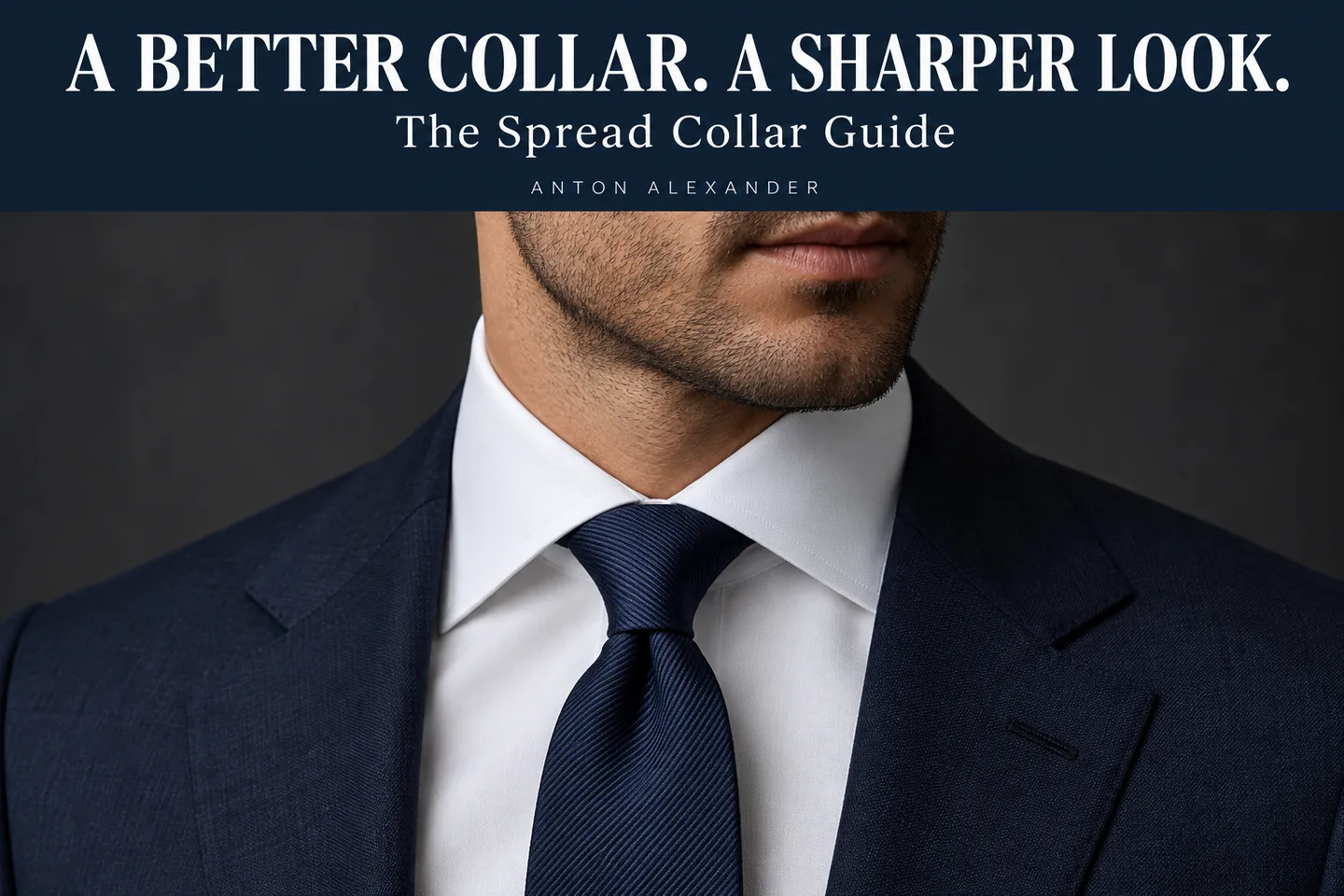
A spread collar dress shirt has collar points that angle farther apart than those on a traditional point collar. The wider opening changes how the collar frames a tie and sits beneath a jacket. Choosing one comes down to the look you want, how you wear your shirt and whether the collar fits comfortably.
Use this guide to compare collar shapes before planning a shirt. For the wider process of choosing fit, fabric and personal details, see our custom dress shirt guide.
Spread collar vs point collar: what changes?
A point collar creates a narrower opening with tips directed more downward. A spread collar directs the tips farther outward. Neither name tells you the neck size, fabric or overall shirt fit. For example, Oxford describes a shirt fabric, while spread describes a collar shape; they are separate choices.
| Style | Main feature | What to check |
|---|---|---|
| Point collar | Narrower opening between the tips | Whether your tie knot fits neatly between the points |
| Semi-spread collar | A moderate opening between point and wider spread styles | How it sits both buttoned and open |
| Spread collar | Tips angle farther outward | The balance between the opening, tie and jacket |
| Cutaway collar | Usually a more pronounced outward angle | The actual shape, since brand terminology varies |
| Button-down collar | Collar tips fasten to the shirt | Whether you want visible tip buttons |
Compare photos and dimensions instead of treating these labels as exact measurements. Collar height, point length and internal structure also affect the finished appearance. Eton’s collar guide, for example, distinguishes several cutaway styles with different proportions.
How to choose a spread collar dress shirt
Start with the outfit you wear most
Think of one actual outfit rather than an abstract dress code. If you usually wear a navy jacket and tie, evaluate the shirt with those pieces. If you normally leave the neck open, make that your first fitting check. A collar that looks appealing in a flat product photo may sit differently on your neck.
Check the collar with your tie
A wider collar opening gives you more space around a tie knot. Try a half-Windsor as a starting point, then assess the result with your particular tie. Fabric thickness changes the size of the finished knot, so the knot name alone does not settle the choice.
Our practical suggestion: compare two knots with the same shirt and jacket. Choose the combination that sits neatly without forcing the collar points upward or crowding the opening. You do not need the largest possible knot simply because the collar is wide.
Try it open, too
You can wear a spread collar without a tie. The result depends on its proportions and construction; Proper Cloth’s President Spread is one example designed for both open-neck and tied wear.
For your own fitting, unbutton the top button, put on your usual jacket and look at the neckline from the front and side. Check whether you like how the collar sits after moving around. That is more useful than choosing solely from a posed photograph.
Collar shape and collar size are separate decisions
A wider spread does not mean a roomier neck. If the neckband feels restrictive when buttoned, changing the angle of the collar points will not solve the sizing issue.
Start with our dress shirt measurement guide, then compare the current measurements on the sizing page. Assess comfort with the collar fastened if you plan to wear a tie. Use the dress shirt fit guide to check the shoulders, chest and sleeves as well.
Spread collar or contrast collar?
These terms describe different design choices. Spread refers to the collar’s shape. Contrast refers to a difference in color or pattern between fabrics. An accent inside the collar is another placement choice.
When planning a shirt, separate your requests: the collar shape, the outer fabric and any inner accent. Our contrast collar and cuff guide shows Anton Alexander examples and explains how accent visibility changes when you wear the neckline open or turn back the cuffs.
What to confirm before a custom order
Use this short checklist when discussing your preferred design:
- Shape: share a reference showing the collar with its top button fastened.
- Wearing preference: say whether you normally wear a tie, an open neck or both.
- Fit: provide measurements using the requested measuring method.
- Accents: identify the body fabric and the intended accent locations separately.
- Availability: confirm that the requested collar construction can be made before ordering.
Explore the current Anton Alexander custom dress shirt options for fabric and design choices. This guide explains collar terminology; it does not mean that every collar style described is offered on every Anton Alexander shirt.
Frequently asked questions
Is a spread collar the same as a cutaway collar?
Not always. Cutaway usually describes a more pronounced outward angle, but naming varies between shirt makers. Compare the actual collar shape and measurements rather than assuming the terms identify one standard design.
Do spread collars require a Windsor knot?
No. Consider the size of the opening and the thickness of your tie. Try the combination on: the knot should sit comfortably and look balanced with the collar.
Is a spread collar a button-down collar?
Spread describes the distance and angle between collar points. Button-down describes points secured to the shirt with buttons. A shirt with buttons down its front is not necessarily a button-down-collar shirt. Our guide to button-up and button-down shirts shows how to identify the front and collar fastenings separately.
Will a spread collar fix a tight neckline?
No. Neckband size determines the room around your neck. Check your measurements and the shirt’s sizing information instead of choosing a different collar shape to compensate.
Which collar is best for my face shape?
Treat face-shape advice as a styling suggestion rather than a rule. Compare your preferred collars with your usual jacket, hairstyle and tie, and prioritize comfort and the overall look you enjoy.
Ready to plan the rest of your shirt? Return to our custom dress shirt guide for help combining fit, fabric, cuffs and personal details.